Thursday, 25 August 2016

Waves of rays

What an incredible week – two inspiring meetings with two very different men – one an artist, the other a scientist - and yet so similar in their passion and depth of knowledge – and both so generous with their time and expertise.

Rex and his wife Rhona welcomed my intern Sila and I [Shelley] in their rambling house in Bromley.
We walked through the sunlit garden into a cavernous studio packed to the rafters with boxes of pianola rolls and presses and ancient computers to find Rex playing a grand pianola at full tilt – the piece that he played for their wedding exactly 12 years ago.


Rex explained how the design of the rolls evolved from 64 to 82 holes to allow for more sophisticated coding, and the difference between the European-style round holes and the American squares. He showed us how the additional lines and dots that I had seen in photographs online are used by the player as a guide for tempo and dynamics and demonstrated the surprising degree of freedom that the player can exert on the way the piece is ‘played’ by the machine.


Stravinsky, among other composers, personally supervised the notation and frontispieces for their new works. A stylised phoenix was the logo for one of the most influential publishers, the Aeolian Company. Rex has adopted this for the home page of his own remarkable software that allows him to design new rolls and cut them himself. He demonstrated the process for us, firing up an extraordinary machine with multiple pulleys and levers and a clattering array of hole punching bits.


Frontispiece for pianola roll

Rex' software home page

Pianlola roll hole punch 
Short video of Rex's software in action


short video of hole punch in action


I had not realised that the whole pianola mechanism is essentially a set of air pipes – the holes release the vacuum and collapse a small set of bellows. This movement in turn releases a hammer which strikes the keyboard of the piano placed behind the pianola mechanism. 

pianola pipe system from the back
pianola pipe system from the front


We chose Bach's Fugue no.2 in C minor from the first book of the Well Tempered Clavier. The recurring triplets of the central theme are coded as a distinctive triangular pattern that dances through the piece.

triplet theme


We left the Lawson household with warm agreement to meet again. Rex will join us for the glassblowing session in Frome in September.

In the meantime, I will send him images of the work as it progresses.


The second meeting was very different but equally memorable – I had met Michael Berry through my PhD supervisor several years ago. We had spent a wonderful afternoon at his house in Clifton discussing glass and caustics and he had kindly agreed to help in future projects.

I was delighted that he was able to spend an afternoon with us when he is so much in demand. We all met at Trowbridge rail station and went to a glassblowing studio run by two very talented young glass makers nearby. Neither Michael nor Scott had ever seen the process at close quarters before and seemed to find it fascinating despite the heat.  James made some Prince Rupert’s drops for Michael and showed us their new coldworking space before we went to a pub by the canal in Bradford upon Avon to continue the conversation.


Katie and James with Michael and Scott

Michael with a Prince Rupert's Drop
Scott with a Prince Rupert's Drop
Scott and Michael
Michael and I


I had tried to read anything I could find on the internet about Caustics before meeting Michael but had become hopelessly confused. With his patient explanation, it all became perfectly clear – and brought Scott and my work into sharp focus.

Until now, we had been shining light through a revolving object. This generated rich and complex patterns of light and shade especially when combined with the reflections generated by the polished facets.

This was the heart of our original proposal– to understand these phenomena to the point where we could direct and refine this luminous vocabulary with greater creative intent.  

As Michael explained, caustics are the patterns of light and shade that are generated by a stream of photons interacting with small changes in the angle of a shiny surface. These undulations essentially operate as mini-lenses, focusing the beam to produce rich networks of curves and points.
The relationship between the scale of the topography and the size of the beam is critical to the effect: a small beam such as a laser pointer will be deflected by very small undulations, a large light source such as an LED lamp will be deflected by larger-scale effects. In both cases, a parallel beam is critical so that a stream of photons strikes the glass from the same direction. A spreading or diffuse beam will create spreading and diffuse effects.

We realised that in order to find the clarity and control we were seeking, we should begin with flat rather than curved surfaces. Rather than looking at the projections created by shining light through the piece, the solution lay in the reflections.

We talked until it was time to get the train home – about parallels between waves and rays of light and sound, the power of prime numbers and the principle of natural beauty.

Michael kindly agreed to continue to advise us as the project progressed.

I was so delighted to get back to the studio to run some experiments with mouth-blown plates with sandblasted patterns to see whether we needed to silver the surface - and it seems that we don't need to after all, .

With Michael’s advice on the light source, have started to get some exciting results.

Caustics from a sandblasted plate

Video showing effect of different distances from the light source


Saturday, 20 August 2016

Caustics caustics!


On August 17th we made a trip to Trowbridge to discuss our project with Professor Sir Michael Berry, a physicist who specialises in caustics, the optical phenomena central to our project.

After meeting up with Michael, the day began with a session watching glassblowers at work; something I [Scott] had never seen first-hand, despite working with a glass artist for over a year. We spent an hour at the Devereux & Huskie Glassworks Studio — friends of Shelley’s — and watched them make a beautiful piece of layered blown glass. The process especially fascinated me for its materiality and intense performativity. The three artists worked together to keep the glass at the correct temperature for optimum malleability, and to keep several kilos of molten glass in constant and even rotation to stop it sliding off the blowing pipe. All of this while continuously shaping and pressing the glass into a unique and elegant form.


We also had some fun watching James and Katie make some ‘Prince Rupert’s Drops’ for Michael.
'Prince Rupert's Drop' or 'Dutch Tears'
After this we went for lunch with Michael to chat about our project, especially the nature of the caustic light phenomena, and their relationship to spectral behaviour in sound. 

Michael is Emeritus Professor of Physics at the University of Bristol. He specialises in the mathematics of light focussing, specifically caustics, phenomena that lie in the 'borderlands between physical theories — between classical and quantum, between rays and waves.' If you’d like the details, Michael’s website hosts his many papers that explain the complex maths behind these phenomena. However, for non-mathematicians, he describes caustics simply as the ‘spectacular patterns of wave interference associated with focusing’: common examples can be seen in the shimmering patterns of light on the bottom of swimming pools and clear streams. This older paper of Michael’s explains the phenomena very clearly, and here’s a beautiful example of a cusp caustic in very fine detail (from Michael's site), and a diagram of caustic formation (from paper cited above).


Talking with Michael changed the way we think about some of our project, or if that's too radical, the conversation at least provided us with another way of thinking about our materials. The primary point for me was that it's possible to generate caustics that are more 'pure' (see below) by removing the refractive aspect of the glass from the equation.  'Pure' here means an image that is only the caustic rays, avoiding multiplying of the image by glass refraction and internal reflections. This is not necessarily the best approach for the project goal of developing a visual grammar for a graphic score, but it certainly provides another aspect to that grammar, another voice. 

The simplest way to do this within our project is to use silvered glass, this allows us to reflect directly off the silver and allowing the curving of the glass to generate the caustic focussing. We can then also contrast that against caustics generated by shining light through the glass, wherein the cording of the glass multiplies and distorts the caustics. Both of these cases provide rich visuals with clearly identifiable elements

A second new element is to trying using laser light as well as white light. Our previous performances have used tightly focussed white light, which gave us good results, but seeing Michael's work with lasers has convinced us to try this approach as well. I've done some experiments using a simple laser pointer, with good results. The patterns from laser light are slightly different (apart from the very obvious difference that they're bright red...) but I haven't yet become familiar enough with them to properly define the different quality: watch this space... Here's an example:


As well as these direct impacts on the project, it was also fascinating to talk to Michael about aspects of chaos theory in his work, as this had a strong influence on my PhD work. I hope to have the chance to chat to him again as the project goes on.


Sunday, 31 July 2016

Spectral Listening


For me [Scott], the central connection between the glass/sound is the analogy between the spectral caustics of the glass, and the spectral splitting of sound. My own compositional practice takes this spectral listening as a basic pre-requisite, allowing me to find new and fascinating ways of working with acoustic instruments to bring out this splitting.

For the uninitiated, spectral listening to sound involves listening 'inside' the sound to hear its structure, the motion of its relative parts. This is not easy to do in most music we're surrounded with because the motion of notes and different instrumental timbres captures our attention, but when presented with single sustained sounds it is easier to focus on their internal structure. A simple example is to listen to a drone (a single sustained note) for a long time.

As an example of music that already take advantage of some sort of spectral listening. In traditional throat singing of Tuva/Mongolia, the singer drones a low pitch and makes subtle changes of mouth shape make it resonate strongly on specific harmonics, which they can then manipulate into a tune: you hear a low note and also a whistle-like tune. Here’s an example from outside the traditional context.

Bells and other inharmonic metal percussion don’t have the same harmonic structure as other musical sounds (see harmonic series below) so it’s often easy to listen past the main pitch and hear other pitches in the bell’s spectrum: bell-makers use terms such as ‘strike note’, ‘hum note’ etc. to differentiate these. See here for a detailed explanation.

Spectral Structure: All musical sounds contain harmonics, each with their own distinct pitches arranged in a sequence called the harmonic series; notably except metal percussion which is ‘inharmonic’.  The pitch that we hear is called the fundamental, and its harmonics are called partials, but we hear all of these partials as being fused together in a single pitch. In the example below, we would hear the bass pitch C on the far left, but that note also contains all the other partials, some louder than others, if we listen into the note it's possible to hear some of these partials.


Here's a brief explanation video showing a realtime spectral analysis of my voice as I sing a drone and change vowel-shape, which changes the spectrum.


Here's an image and video below of a french horn solo as a spectrogram: Marie-Luise Neunecker playing an excerpt from the end of the french horn solo in Britten's 'Serenade'. Unlike my voice example, here time passes on the x-axis (left-to-right) and the partials/frequency are represented on the y-axis, low-to-high. Each note is a series of lines, with the lowest being the fundamental and the upper partials becoming more faint as they get quieter: loud notes are dark, and have more dark lines showing strong partials in their spectrum.


In most of my music, I use acoustic instruments played in ways that focus the acoustic energy of the sound away from the fundamental, to create a harmony from the partials; either on their own as harmonics, or in more ambiguous formats where individual partials bleed through the overall sound. This example below is from a solo violin piece — The endless mobility of listening (2016) performed by Mira Benjamin — where the violin's open G string is played as a drone, but with changes of bow speed/pressure that bring out partials. The spectrogram is of the same file, and looks as ambiguous as it sounds. Notably, the fundamental 'G' at 196Hz is practically invisible on this spectrogram, with all the energy pooling into other partials, most notably the 3rd and 6th (both sounding as 'D'), and sometimes the 7th (a slightly flat 'F'). However, we still hear ‘G’ overall because the brain condenses the harmonic series into a single pitch percept: this is why spectral listening takes time, you have to work around the brain’s tendency to reduce to one pitch.


In some of my work on this project, I've looked to make a performance where the shifting patterns of light caustics from the glass become a score played by splitting the sound of acoustic instruments to bring out partials. The light is energy in a caustic is similarly split, and pools in specific resonances that cause bright curves and lines. The question in our project is how to meaningfully map this for musicians such that (a) it's not completely prescriptive, allowing some indeterminacy and complexity, but equally (b) it's not simply free improvisation along to beautiful visuals. There must be some connection and some freedom. From the other perspective, the project hopes to build a grammar from glass and light that allows us some consistency in structuring the music. We have some great results so far, looking forward to more exploration!

Thursday, 28 July 2016

Souding Boards


Scott and I [Shelley] had spent hours on the phone and by email together, dreaming about all the things we would do with this grant. With the wonderful news that we had been selected, we started planning in earnest – how could we make the very most of this unique chance to explore our common fascination with coded structure or grain without compromising our very different creative practices, - and do all that within a limited time and budget?  And would the process of analysing and describing this creative friendship quench the spontaneity, the spark that has fuelled our work so far?

As I swam up and down my local pool pondering these questions, I remembered an inspiring conversation with a leading authority on pianolas, Rex Lawson, who had, by chance, visited my studio during the Open Studio event at Cockpit Art in June with his wife. Perhaps the coded materiality of the pianola roll might be a useful common ground. And perhaps the rich and distinctive symmetry of a Bach Fugue would provide a framework for the creation and arrangement of the glass pieces.

I was also worried about how we might analyse and interpret the projections themselves- to move beyond a simple metaphor (‘bright = loud’) to offer a more sophisticated link between the optical and acoustic phenomena. Another connection, this time from my Bristol psychology network bubbled into view. The physicist Sir Michael Berry is an old friend of my PhD supervisor, Priscilla Heard and we had met with his wife for tea two years ago. He seemed as fascinated as I with the caustics created by the glass objects and several hours flew by as we toured his rambling house with torches peeping into darkened rooms filled with experiments. Perhaps he would be willing to help.

Scott seemed excited by the idea and we agreed to make a start. I contacted Rex who was traveling and unable to help with the Bach piece in time for our first workshop. Scott found a section of a roll of a Beethoven piece and sent over a series of scans- we both instantly liked the patterns in ‘page 4’ so I imported this segment to a 3d modelling programme to recreate the original grid, borrowed a desktop plotter / cutter from a friend to create the stencils and sandblasted a series of tests on different types of glass – a borosilicate drawn tube, a mold-pressed kilner jar, panels of window glass and mirror.
Beethoven 'Moonlight Sonata' pianola roll fragment


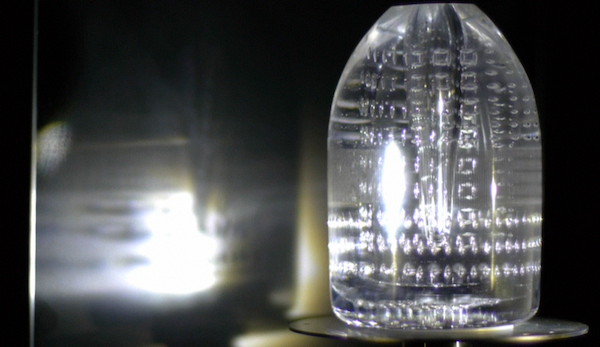
Kilner Jar (Photo: Michael Coldwell)


I loaded a backpack and set off to meet Scott in the sunlit plaza in front of Huddersfield station. A wonderful warm evening with Scott’s wife and daughter set the scene for an incredibly productive day in Leeds.

We started with the ‘Principles of Collaboration’ exercise over strong coffee and slabs of cake, delighted and relieved to find that, rather than dulling our enthusiasm, the exercises reinforced our confidence and got us thinking about new ideas.

Back to the music department to set up the lights and the glass and to meet Mick, a hugely talented Leeds-based PhD student in Moving Image that Scott had invited to work with us to document the project, particularly taking still shots of the glass objects themselves. He was instantly engaged, pulling out his camera to begin work and making excellent suggestions – the results are wonderful. We’ve asked him to help us with filming performances too. It’s great to have him on the team.

We finished the day with a review of the work so far and animated plans for the months ahead strolling through the afternoon sunshine– exciting times  


Borosilicate tube end (Photo: Michael Coldwell)